Wednesday, May 1, 2024

The Spring Bride by F.E. Farwerck

 In Tacitus' Germania, which provides descriptions of various Germanic tribes in its final chapters, we find mention of several tribes such as the Reudigni, Aviones, Anglii, Varini, Eudoses, Suar-dones, and Nuithones. These tribes lived in areas protected by forests and rivers. Tacitus notes that although there are no specific details about their way of life, they all shared a common practice of worshipping Nerthus, also known as Mother Earth... On an island in the sea, there is a sacred forest, within which rests a revered wagon veiled in cloth. Only the priest is permitted to handle it. He perceives when the goddess is present in the innermost sanctuary and accompanies the wagon, which is pulled by cows, with the greatest reverence. Then come joyful days; all places where the goddess graciously visits and is a guest are festively adorned. There, strife ceases, and weapons are set aside. All iron is locked away. Only peace and tranquility are known, only these are cherished until the goddess is satisfied with her interaction with humans, and the priest leads her back to the sanctuary. Then the wagon, cloth, and, if one chooses to believe, the goddess herself are cleansed in the lonely sea..

Nerthus procession

Here we clearly have a ritual of worship, similar to what we find among other peoples. In the Phrygian cult of the Great Mother, held in Rome since Emperor Claudius in March, they paraded the image of the Great Mother in a wagon pulled by cows, and finally, it was bathed in the Almo, a stream that flows into the Tiber. It is therefore not impossible that we see in Nerthus a variant of an Indo-European mother goddess, and that her procession celebrated the reawakening of Mother Earth.

The name Nerthus is not transmitted to us from Scandinavia, but that of Njordhr is, which etymologically corresponds precisely with it. However, in Scandinavia, Njordhr was a god and not a goddess. He was the father of Freyr and Freyja, of whom the former was especially revered as a fertility god. Perhaps there were once a brother and sister, Njordhr-Nerthus, and the worship of one was preserved in Scandinavia and the other in Germania, while in the former land, the old pair was revived as Freyr-Freyja. However, this is only a conjecture for which there is no evidence.

In an old saga, a Swedish religious ritual is recounted, where a priestess rode around a man believed to be the god Freyr, and to the great joy of the people, she became pregnant. Apparently, this was seen as an omen that the god's fertility powers would also extend to cattle and crops. It appears that we are dealing here with a similar practice as in the procession of Nerthus, which presumably also related to fertility. Originally, the procession likely involved an image of Freyr. There have been various explanations proposed for the name of the goddess, but only three are somewhat plausible. Firstly, the name is associated with the Sanskrit word "nrtd," meaning dancer. Dance held great significance in the worship of all ancient peoples, including the Germanic tribes, and it is possible that the goddess's procession was accompanied by dancing. Secondly, some connect the name with the Celtic "nertos," meaning strength, particularly emphasizing vegetative forces closely associated with the worship. Lastly, some link it to the Greek word "nerteroi," meaning the dead. As Mother Earth, a chthonic deity, Nerthus may have also been a goddess of the underworld, which according to various Indo-European and non-Indo-European beliefs, was closely tied to fertility, as life emerged from it.

Tacitus also mentions in his Germania another goddess revered by the Suevi, whom he refers to as Isis. Presumably, he followed the Roman custom here and gave the goddess a name that was known among the Romans and of which the bearer more or less possessed the characteristics that were communicated to him of the Suevic goddess. 'A part of the Suevi,' he says, 'sacrifices to Isis.' The meaning and origin of this strange cult I could not ascertain; only the emblem, shaped like a ship, indicates the introduction of a cult from across the sea—a conclusion that we entirely leave to Tacitus' account. We have images of the Egyptian Isis, with which he apparently identified the Suevic goddess, sitting in a boat. Cows were dedicated to her, and she was, among other things, a goddess of fertility, the underworld, and the sea. Similar representations were perhaps also associated with the Suevic goddess, and this was presumably the reason for Tacitus to label her with the name Isis.

Isis

A third goddess, who may have been the same under a different name, has been handed down to us as Nehalennia. Like Isis, she is also depicted with a ship. Ship and wagon, however, seem to be interchangeable attributes, sometimes combined in the form of a ship-chariot. Other forms of the same attribute may be the sled and the plow, with which in various folk customs processions are made in the spring. The connection between ship and fertility may be indicated by the tradition that the Scandinavian Freyr, the god of fertility, possessed a miraculous ship, Skidbladnir, which could be folded up like a cloth.

Nehalennia


Tacitus's account is notable for mentioning a goddess and a priest, whereas Scandinavian lore speaks of a god and a priestess participating in a procession, during which the priestess's pregnancy played a role. It is possible that both instances involved a "hieros gamos" [holy marriage] as part of the ritual, a phenomenon seen in various forms among different cultures.

Within the Eleusinian Mysteries, a ritual likely symbolizing the union of Zeus and Demeter, or more broadly, the Sky Father and Mother Earth, was enacted. Here, the hierophant and a priestess symbolized the divine couple, with the hierophant concluding the ceremony by displaying an ear of wheat, symbolizing the anticipated outcomes of the divine union. A similar practice was observed in the annual union of Dionysus with the 'queen of Athens,' representing a woman of high moral standing from the city. This ritual, held in February, aimed to boost the fertility of grapevines and other plants sacred to Dionysus. Homer's Iliad also celebrates the union of Zeus and Hera, linking their marriage to the flourishing of nature on earth. Customs in Argos and Samos involved leading a priestess to the temple, part of which included preparing a ceremonial bridal bed. Pausanias's writings mention Hera's annual bath in the Kanathos spring, symbolically renewing her virginity. These myths and rituals collectively underscore themes of fertility and renewal. In ancient Rome, kings were regarded as representatives of the fertility god and held personal responsibility for agricultural success, a belief echoed in Scandinavian traditions. 
The legend of the marriage between the Roman king Numa and the nymph Egeria likely preserves remnants of the "sacred marriage," in which the kings of Rome once united with the goddess of fertility. Some have argued that the Greeks, Romans, and Germanic peoples borrowed these rites from Oriental religious practices, where the mother goddess often held a dominant role. However, an Oriental analogy does not necessarily imply that the ritual was borrowed from the East, even when one considers the argument that these rites should be seen as non-Germanic. Such reasoning only aligns with more conservative modern views. We can assume that for a farming society like the Germanic peoples, where fertility in crops and livestock played a crucial role, the connection between agricultural fertility and sexuality was apparent. They likely celebrated the renewal and fertility of nature through a ritual where human procreation symbolized what was happening throughout nature.

Marriage of Numa and Egeria

Some support for this idea may be found in the following. In Sweden and adjacent areas during the Bronze Age (1600–800 BCE), many rock surfaces with numerous engravings were covered. The meaning of these engravings was long debated, but it is now established that they depict, at least in large part, religious rituals. Among these engravings are numerous depictions of ships, the significance of which is not always clear due to the lack of specific details. Ships featuring dancers, horn players, a sun symbol, a deer, or a tree, or ships carried by a man, likely played a role in cultic processions where the ships were presumably pulled on sledges. At Sandéker in Bohuslän, there are two images of ships that belong to this category. On the first ship is a deer, a sacrificial animal par excellence, which was likely sacrificed after being carried in a ship during the procession. A trace of a similar ritual is found in the now largely disappeared practice of leading the decorated Easter ox through the streets before it was led to slaughter. On the second ship are a man and a woman performing a hieros gamos ritual. Evidently, this was a religious ritual deemed worthy of being documented in the rocks.

Rockcarvings at Sandéker in Bohuslän

From the centuries after the Christianization, we have several reports similar to what Tacitus has conveyed to us. For instance, Gregory of Tours, the Frankish historian born around 540, relates that in Autun, the Franks had the custom of driving the statue of a goddess in a cart pulled by oxen, with the intention of safeguarding the rye against natural disasters. However, detailed information is lacking, so the complete context remains somewhat speculative. Cult wagons, likely used for a similar purpose, have been preserved to this day. The image below shows a wagon found at Dejbjerg in Jutland. Also, in the Oseberg ship, originating from the Viking Age and found in a burial mound possibly belonging to Queen Asa of Vestfold, the mother of the historically known Harald Fairhair, such a ritual wagon was discovered amidst numerous ceremonial and artistic objects.

Dejbjerg Wagon

A depiction related to that of a goddess transported in a wagon can be found in the stories about Frau Holle, which were circulated during the Middle Ages and even afterward. They are not mentioned in older sources, but this does not exclude the possibility that they already existed back then, given that very little from Germanic antiquity has been preserved. Frau Holle was sometimes believed to live in a pond, sometimes in a mountain, but mostly underground, displaying various characteristics of an underworld goddess, especially because she is associated with fertility. According to legends, she rides in a wagon, and her annual procession was thought to take place during the "twelve nights," the period between Christmas and Epiphany. It was primarily this procession that brought fertility, but Frau Holle also traveled at other times, such as during the flax harvest. Her connection to fertility is also evident in the custom in Kerstlinrode of leaving a handful of uncut ears of wheat during the harvest as a thanksgiving offering to Frau Holle. The procession of Frau Holle in her wagon is likely related to that of Berchta with a plow and also to that of the "countess in a black coach," with the latter variant likely intended to provide a "natural explanation" for the supernatural elements deemed undesirable in the legend.

Frau Holle

In Christian times, spring was associated with Mary in the form of May festivals, through which she adopted various traits of the pagan mother goddess. This is particularly evident in her association with fertility. She is often depicted in a blue mantle adorned with ears of wheat, and according to legend, in 1694, she caused three ears of wheat to sprout from the snow at a location where she wished to have a church built. Similarly, around a Marian statue in Kaltenbrunn, Tyrol, ears of wheat are said to have grown miraculously, although no one knows how. Old pagan beliefs and rituals were also transferred onto various saints. For instance, in Nivelles, Belgium, the wine of St. Gertrude was drunk from a glass shaped like a ship, and like Nerthus, the statue of this saint was paraded in a wagon, which was later kept in the church for a long time.

In latere folk customs, we find various traces that remind us of the old pagan rituals. However, they are no more than traces because, influenced by the Church, the original meaning has been largely lost over time. Due to this forgetfulness of the background, there has been a mixing with various foreign elements and loss of other components. As a result, these later folk customs, which have almost ceased to exist now, have preserved very little of the old rituals except for a few main features. Yet, it is precisely these few features that point towards the old beliefs, although it is difficult to historically prove their origins.
One of these folk customs is that of the May Queen. In France, on May 1st, the "reine du printemps" [queen of spring], dressed in white and wearing a flower crown, was paraded in a wagon followed by a procession in the Cote d’Or region. In the Jura department, a girl led by shepherds and adorned entirely with flowers and ribbons was called "la belle de mai" or "la reine de mai" [the beauty of May or the queen of May].

The crowning of the May Queen


The antiquity of this custom is evident from a mention by a prior of the Saint-Claude monastery in 1466 regarding a gift given by the monastery, which was intended for "the queen and the nine girls under nine years old who formed her entourage." In Bresse, a girl called "the bride" walked through the village on May 1st, also adorned with flowers and ribbons, accompanied by a young man. In England, the May Queen tradition was quite widespread. In Warwickshire, it was represented by a little girl paraded in a wagon. This tradition also persisted in parts of Germany for quite some time, but like in England, it often merged with customs related to the battle between winter and summer.

The old customs were forbidden in Christian times. If banning them outright proved impossible because the population held onto them despite the prohibitions, they were modified and associated with Christian holidays. This was not done uniformly everywhere, and so we see the May Queen tradition in our country associated with Pentecost. There are already old examples of this practice. Aegidius, who wrote a history of the bishops of Liège in the thirteenth century, mentions that during the time of Bishop Albero, who died in 1155, the priests, along with the people, would choose a girl from among the priests' concubines as their queen during the festivities from Easter to Pentecost. She would be dressed in purple, adorned with a diadem, and placed on the bishop's throne. The clergy would then dance a round dance while singing psalms and honor her as a goddess, "as if they were possessed by idolatry," adds the writer indignantly.

We also find, as a purely Dutch folk custom, especially during Pentecost, the practice of parading a girl known in the western regions as the "pinksterblom" [Pentecost flower] and in the eastern regions as the "pinksterbruid" [Pentecost bride]. The customs do not differ much. A girl dressed in white and adorned with flowers walks through the village, sometimes being carried on a platform. This tradition has persisted in some places until our century. One of the reasons why it was not abolished earlier, like many other misunderstood customs, may be because the Pentecost girl collected gifts that benefited the participants.

Pinksterbruid

Next to the processions of various descendants of the fertility goddess, we also find the custom of young men or boys parading as the May King, May Count, or similar titles, which may have been the last distorted remnants of an ancient procession of the fertility god, influenced primarily by medieval forms and beliefs. In Antwerp, the May Count held his processions around mid-Lent, a practice associated with Count Louis' entry into Antwerp in 1358, clearly aimed at erasing any connection with pagan times. May games were held in Sweden and Norway, where the May Count led a procession, and this custom was widespread in Lower Germany as well.

May King and Queen


Besides the independent role of the May King or May Count and that of the May Queen or Pentecost bride, there are also examples where a boy and a girl jointly hold a procession. An example of such a practice in Bresse was mentioned earlier. In East Flanders, it was customary until 1930 for the May guild to plant a Maypole. At sunrise, the May Count stood before the pole, the girls circled around hand in hand singing, and the May Count then crowned one of them with a wreath, making her the May Countess. Various forms of this custom are also known in Germany, where a May King chooses a May Queen, and in England, they also had "the lord and lady of May." In Twente, during the May processions, Jaan and Greet often participated, two humorously dressed individuals usually with a baby carriage. Here, the couple is portrayed comically, but the baby carriage might hint at a marriage ritual as its origin. Finally, it's possible that in the old children's game, which was also popular among adults and began with the words "There walked a little priest along the side," we see a distorted form of an old spring custom. The lines "hey, it was in May" and "come priest, give your nun a kiss" at least point in that direction.

Dance around the Maypole


In these and similar folk customs, three traces can be found that suggest a possible connection with the distant past. First is the practice of parading the May Queen or any other name given to the girl in a carriage; carrying a girl or boy on a litter or on a ladder may be variations of this. Furthermore, it is noticeable that there is often a reference to a wedding: the name "bride" or the appearance of a May couple. And finally, during the processions, there are often dances performed, which may be related to Nerthus and the cultic dances performed in ancient religious ceremonies.

F.E. Farwerck in Nehalennia, March 1957.


Monday, April 22, 2024

The first depictions of the crucifixion in the North by P. Paulsen

After the North Germanic peoples had lost their expansive power due to their distant expeditions, wars, and settlements abroad by the middle of the 10th century AD, an invisible power began to take hold firmly in their homeland and spread everywhere: Christianity. Its influence was felt from three directions. In the West (with ecclesiastical centers in Ireland and artistic centers like Winchester and Canterbury in Southwest England), lively relations existed. From the South, supported by political and ecclesiastical organizations, it penetrated through Jutland into the North. And in the East, Rurik's descendants had already created conditions for the spread of Christianity through their rule over the vast Slavic plains until Vladimir of Kiev opened the gates for the Greek Orthodox Church of Byzantium and allowed the unleashed stream to penetrate deeply into the lands between the Black Sea and the Baltic Sea.

Now, a period of conflicts, change, and altered perceptions began in the North, a time of mixed faith that left strong traces in grave finds and visual arts. Opposed to the main motif of the North, the animal, arose the main motif of ecclesiastical art from the mentioned directions: the plant, the tendril. Alongside various symbols, the motif of the crucified soon appeared in different discoveries and monuments.


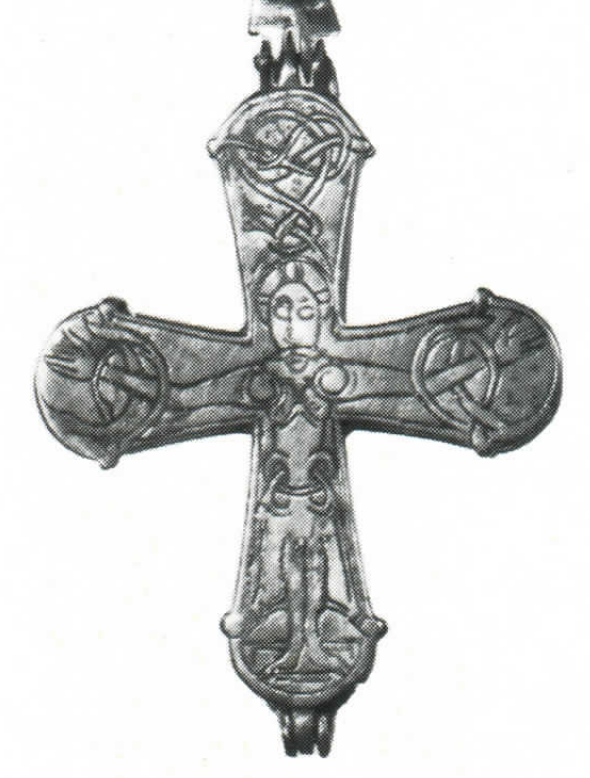
Fig. 1

From Birka (Uppland, Sweden), a grave from the mid-10th century contains a carrying cross among other ornaments (fig. 1). The entire execution in filigree and granulation is highly stylized. In the long pointed chin, a beard is probably depicted. The specially applied dots at the wrist joints and the body are considered to represent tendrils, according to the design found on a similar cross, namely that of Gätebo in Öland. On this imitation of a Byzantine enkolpion, the crucified figure hangs amidst stylized acanthus tendrils (fig. 2). A beard and mustache are depicted, and the aureole resembles that on the Jelling Stone! Connections between the arm and body are marked by the characteristic Norse art spirals. Near the body, we see the Norse chain motif.


Fig. 2

Whether it represents a tendril or a stylized bulging fold of the garment is hard to discern. The robe, with its hem forming an arc and tapering to points at the ends, is depicted similarly in Irish work and also in Gotland. However, the entire remarkable representation becomes clear with the explanation of the figure on one side of the large Jelling Stone (fig. 3). On the large runestone and figure stone at Jellinge in Jutland, a figure with outspread arms appears. It is clad in a richly pleated king's mantle that does not extend all the way to the knees. A radiant halo shines behind the head, the wheel with four spokes. Double cords are formed from a round sling at the mid-body, which ends in a trefoil with leaf-like points and also encircles the outspread arms. At the feet on the left and right lie trefoil tendrils. The entire composition is framed by twisted tendrils, forming trefoil tendrils again at the three edges. Thus, we see the sacred numbers "3" and "9" represented by these trefoil tendrils. The trefoil tendril is often interpreted as the symbol of the Trinity for Thor, Odin, and Freya. In the latter days of Germanic beliefs, it was considered Odin's symbol. The Odin myth gave the entire image its distinctive form. In the Havamal from the Edda, it is said:

Hung was I     on the windswept tree;
Nine full nights I hung,
Pierced by a spear,     a pledge to the god,
To Odin, myself to myself,
On that tree which none     can know the source
From whence its root has run.

The crucifixion was not familiar in the North, nor did they understand the crucified himself. Therefore, they sought a connection with corresponding concepts from Germanic religion. Thus, Christ hovers like a Norse warrior in a king's mantle, entwined by tendrils, at the peaks of the world tree, whose roots lie deep in the primordial fate. Just as Odin sacrifices himself for knowledge and wisdom, so Christ sacrifices himself for the sins of humankind. From this representation of the crucifixion emerges the era of mixed faith, depicting the intertwining beliefs of that time.

Fig. 3

Peter Paulsen in Hamer August 1942

Thursday, April 18, 2024

The belief in a predetermined fate (part I) by F.E. Farwerck


Almost all Indo-European peoples have a belief in a "sacred order of things" established and maintained by a power above humans and gods. Inextricably linked to this belief is the notion that fate, which befalls humans and the world, is irrevocably fixed and that no human can change it, not even the gods themselves are exempt from this fate and cannot alter it. Although we see deviations from this rigid standpoint over time, this likely occurred because people could not reconcile this fixed fate with other concepts, such as the idea of "free will," which seemed to hold great allure in later years. Additionally, some gods were later no longer seen as subject to the power of fate but rather identified with it, making them the determiners of fate. However, apart from these and similar interpretations, we see everywhere that originally, there was a belief in a higher power that determined all events and against which nothing could be done. This concept has somewhat transformed into the Indian concept of "karma," which has persisted.

Both the Indians and the Persians believed that a power of fate ruled over the world, the gods, and humans, in all areas of material and spiritual existence. Although we also find here the opinion that a person's fate is partly the result of their own acts of will, as we read in the Yajnavalkya (I, 130): "just as the movement of a chariot does not come about by a single wheel, so the fate (daivam) of a person does not come to fruition without their action," this is only an apparent deviation because human actions are also dependent on fate. The emphasis is always on the belief that everything happens through the power of fate. This fate cannot be overcome (Mahabharata IX, 65, 30) or diverted by heroic strength (ibid. XIII, 29, 19), because fate is always the most powerful. Even the gods are powerless against fate. Indra, who intended to save Kandawa from downfall, could not carry out his plan "when he realized that Kandawa's downfall was determined by fate."

 In Persia, Zarathustra sought to replace the power of fate with the god Ahura Mazda, but since the first century BCE, the belief in an omnipotent fate god, Zurvan, spread, gradually limiting the influence of Ahura Mazda, who according to Zarathustra was the highest power, because it was no longer this god, but Zurvan, who dispensed blessings and curses. This was probably a return to an older belief that existed before Zarathustra's religious reform.

Even the Greeks believed from ancient times in the existence of an all-controlling, predetermined fate. We can find confirmations of this, among others, in the Iliad. When Sarpedon says to Tlepolemos (Book V, 653), "Here on this spot you will undergo death and the black fate from me," it indicates that he sees himself only as the executor and not the cause of this fate. In the sixth song, Hector says (line 487), "No one will send me to the shadows against the will of fate." Even where Homer does not let individuals speak, he repeatedly emphasizes that fate determines everything. In the eleventh song (line 332), he says: "The dark fate drove them forward," and in the eighteenth (line 251), "I think none of mortals ever escaped fate," and there are several similar statements that can be cited. Even Zeus could not change fate, and when considering Hector's fate, it was clear that he was doomed to death, and the god could not change that.

It was believed that each person received their fate at birth, and this fate was referred to by the name "moira". This word signifies that part of life that one receives, with all its vicissitudes, especially with their inevitable death, which occurs at a specific time. From this concept of fate, we see various developments among the Greeks, and later we find various goddesses like Ananke, Tyche, Nemesis, and others taking the place of the impersonal fate power. In Rome, they knew the three Fatae, the Fates, and also, but only in the language of poets and philosophers, the concept of "fatum". In Cicero, we find this word meaning "the eternal established order of nature," and in Ovid, Horace, and Virgil, it means "the eternal unchangeable fate." The three Fatae are depicted as three women, but sometimes also as one man with two women, while occasionally a single woman is found, resting her foot on a wheel. Other personifications of fate are also found among the Romans, where it is notable that the older notion that fate stood above the gods is no longer found. Here, it is the gods and especially Jupiter who determine the fortunes of people and nations through pronouncements that reveal their will.

Also among the Germanic peoples, the belief in a predetermined fate existed. It persisted even into Christian times, and nowhere was the concept of submission to an all-controlling fate taken as uncompromisingly seriously as with this people (Gehl 1, Belief in Fate, page 234). This belief was not connected to belief in the gods. Even in the time of the Icelandic sagas, a century or two before Christianization, it is evident that those who did not believe in the gods but only trusted in "their own power and strength" — an expression we encounter repeatedly — had an unwavering belief in inevitable fate. But there were no believers in the heathen gods who had lost faith in fate. One gets the impression that all, whether believers or unbelievers regarding the gods, were equally fate-believing (Baetke, page 64). The belief in fate was thus more a part of their worldview than their religion, although the division between the two was not as sharp as in our times, and that dividing line seems to have been drawn deliberately. Specifically, the gods were not made the determiners of fate — except in a few exceptions, such as Odin granting military success — and neither were the personifications of fate given a divine character. As a result, these figures were never involved in worship, and they generally did not receive divine reverence, although there are traces of veneration of the three Mothers, who may represent a form of the three weaving Norns, who, however, did not do as they pleased but as they must.


Even the gods were subject to the all-controlling fate. They could investigate the decrees of fate, but they could not determine, change, or stop them. In the myths of the gods, we repeatedly see how especially Odin, the chief among the gods, constantly ponders the future and seeks to fathom what fate will bring to the gods, the world, and humans.

The great significance that the belief in fate had among the Germanic peoples is evident from the many words they had for that inevitable force that determined everything in life. Often, these words had the meaning of "death fate," but they also had numerous words for general destiny, many of which were common Germanic terms. The scope of this discussion does not allow for a discussion of all these meanings, and over the centuries, with the decline of the belief in fate, many of these words disappeared. In modern languages, few words in the old sense of "inescapable fate" remain. In Dutch, we still have words like "lot" and "noodlot" (fate and doom), as well as words like "bestiering" (guidance) and "beschikking" (decree), and also vaguer expressions like "bestemming" (destiny), "toekomst" (future), and so on. Most of these words now carry the meaning of fate determined by divine intervention. The word "beschikking" is related to an older Dutch word "schicksel," which means fate and corresponds to the still-used German word "Schicksal." In the Scandinavian languages, we still have most of the words that recall the old designations, but there are also some newer ones alongside them.

One of the oldest written records of belief in a fixed fate can be found in the Icelandic Edda, a collection of poems that were likely orally transmitted for centuries before being written down. In the Song of Skirnir, he says (stanza 13):

"The day of death is destined for me; fate has determined my life's course."

We also have an old written indication from the southern Germanic region. In the Hildebrandslied, when the old Hildebrand realizes that the opponent he is fighting is his own son, and when this son does not believe that his father is against him, Hildebrand is obliged, for the sake of his honour, to fight his son to the death and thus jeopardize the survival of his lineage. But he does this because he has no other choice, as being considered a coward would be even worse, and when he says the words "wewurt scihit," the ominous fate unfolds. Although written records in these southern regions were strongly influenced by Christianity, and pagan ideas are therefore sparingly expressed, we still have an Old English saying from England that, although showing Christian influence, still reveals the old belief. This saying goes: "Wind is in the air the strongest, thunder of the noise the greatest, the deeds of Christ are great — Fate (Wyrd) is the mightiest." The term "Wyrd" refers to one of the personifications of fate, handed down to us from Scandinavia as the Norn Urdh, and it also still shines through in the word "wewurt" used by Hildebrand; probably, the wind refers to Odin and the thunder to Thor, so the saying originally meant that fate was stronger than the gods. The phrase about Christ was apparently added later, but it was placed on par with the pagan gods and made subordinate to fate.


The belief in an all-powerful fate is clearly demonstrated in numerous ways from the North. We find these especially in the sagas, primarily in the Icelandic sagas, which describe the experiences of the colonists settling on the island and their descendants, especially from the times before and during Christianization. Time and again, it becomes clear how people believe that the future is not dependent on human actions or desires but rather on the all-controlling factor of fate, which even determines human deeds.

This fate-controlled future has, from a human standpoint, three aspects: the fortune that befalls a person, the misfortune that strikes them, and the events that have a neutral character. Nowadays, when we use the word "fate," it is mostly in the sense of "doom," but in ancient times, it also encompassed the other two aspects equally emphatically. Whatever happened to a person was part of the execution of fate's decrees, although even then it was human nature to emphasize the unfavourable experiences the most. However, alongside that, there are frequent mentions of a fortunate fate, which to a large extent depended on the luck inherent in a person or that came upon them, a fortune that could also be lost.

This inherent luck could encompass various aspects: noble lineage, long life, status, wealth, intelligence, beauty, and so on. Many people possessed such luck, but there could also be a "lucky man" par excellence, whose luck could be compared to "mana." It was believed to be strongest among the ancient lineages and especially among the royal lineages, so much so that the king's fortune could benefit the entire population. However, it could also happen that the king's fortune deserted him, resulting in lost wars or failed harvests, and the only solution could be the king sacrificing himself to the gods, an idea found among many ancient peoples.

Just as the actions of a lucky person brought them luck, the actions of an unlucky person were turned into misfortune. This belief still exists more or less today, and we still hear phrases like "he was born for misfortune" contrasted with "everything goes well for him."

Although they did not fear death, they considered it fortunate to live long lives. If someone's time had not yet come, they would continue to live, even when it seemed likely that they would not survive. In the Saga of Harald the Skald-King (chapter 1), Ingjald's farm is surrounded by enemies who set it on fire. Ingjald goes outside and asks for safe passage for his men, but it is denied. He then speaks to the young men Ottar and Avaldi, who are with him: "It seems my fate is sealed here. But I would like you to escape the fire and live longer. I will show you a secret door to exit. Later, when you have risen in power, you will have ample opportunity to avenge this." They agreed, and Ingjald let them escape through the secret door. He stayed behind because his sense of honour did not allow otherwise; he had not requested safe passage for himself for the same reason. His sense of honour sealed his fate. The saga notes about the young men: "They passed through fire and the noise of weapons and continued towards the island, destined to live longer. They escaped and reached a farmer living on the island." In the Laxdæla saga (chapter 15), we read about several men swimming in ice-covered water. It was a perilous undertaking, but the writer says: "Because they had strength and bravery and because it was destined for them to live longer, they crossed the river and reached solid ice on the other side." We find a clearer example of someone's life being determined by fate in Snorri's Heimskringla, in the story of King Olaf the Holy (chapter 99). After jarl Thorkel defeats jarl Einar of the Orkneys, the writer notes, somewhat surprised, that none of Einar's men attempted to avenge him. He adds, "It had to happen according to fate because Thorkel was destined to live longer."


Even in situations where death wasn't involved, everything was considered dependent on fate. In the Saga of Wise Njal (chapter 6), Hrut asks the King of Norway for permission to return to Iceland. When the king inquires about the reason and asks if he expects to be more honoured in Iceland than in his court, Hrut replies, "Perhaps not, but everyone must accept what is destined for them." Gunnar expresses this even more strongly in the same saga (chapter 31) when he wants to sail to Iceland and King Harald suggests that he may not return. Gunnar responds, "That is up to fate, my lord."

Fate determined every aspect of human life, including one of its most significant points, death. It is repeatedly emphasized that there is no escape from death, no matter what precautions one takes. In the saga named after him, Njal (chapter 68) warns Gunnar to be cautious in the face of imminent danger, Gunnar responds, "If it is destined for me, I will meet my death, no matter where I am." Similarly, Grim reacts when Hallmund dies, saying, "Everyone must depart when their time comes." We still hear similar sentiments today in common sayings like "No one goes before their time."

In the Saga of the " Góði " (chief-priest) Snorri, Arnkel decides to go abroad. He can take his movable property with him, but the immovable property that he cannot sell must be left behind. He accepts this with the words: "So let it go with the lands that cannot be sold, as fate determines."

The extent to which fate, as they believed, intervened in personal actions is evident in the words spoken by Gisli to Aud after she told him about her conversation with Thorkel. He said, "I see no counsel here that is valid, but I will not be angry with you for it. For everyone speaks what fate prompts them, and what must happen, happens."


What befell a person, the fate that was his, was not regarded as important as it may seem to us today. Much more important was the attitude that a person adopted towards his fate. For the Icelander — and this attitude probably applied to all Germanic peoples in pagan times — it was not so much about what became of his life, but rather whether he ultimately triumphed over this life, whether he died as a hero or as a weakling. What fate had allotted to a person, he could not escape. He had to accept that, but everything depended on the attitude with which he did so. Even deeds performed in one's life did not carry as much weight as the attitude one adopted towards fate. In the Saga of Hord, it is said: "That he became a criminal was partly the fault of his companions, but on the other hand, no one can escape their fate." When the majority of his band rejected his plan to cease hostilities, Hord said: "What is destined must happen, and indeed, it is not easy to resist this. But I have no desire to continue participating in these hostilities any longer." The saga writer then expresses satisfaction about him: "Everyone praised his bravery, friends and enemies alike, and in his time, there was no one more heroic and wise than Hord."

F.E. Farwerck in Nehalennia, September 1956


The Origin of our People

When one lays before oneself a map of Europe—not one showing political divisions, but one of the land’s natural features—one’s attention is ...